Count the Watts: A Room-by-Room Electrical Audit for Dorm Rooms and Student Rentals
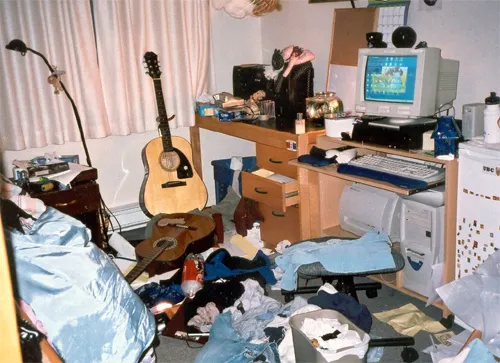
Photo: Gillian from Vancouver, Canada, CC BY-SA 2.0, via Wikimedia Commons
The drawer beside a residence hall bed is rarely empty. It holds a laptop brick, a phone cable, a braided USB-C cord of uncertain origin, a portable battery pack, a gaming headset, and — since move-in weekend — a six-outlet power strip with every port occupied and no space to breathe. Nothing about that drawer looks dangerous. That is precisely why it goes unexamined for nine months.
Electrical failures in student housing do not usually announce themselves. They accumulate: a cord pinched behind a desk leg, a charger bought from a marketplace seller for nine dollars, a battery pack that has lived at full charge since sophomore year. This audit takes about twenty minutes, and it is worth repeating at the start of every semester.
Start with the three ways charging gear fails
Heat. Chargers and battery packs generate warmth in normal operation. Confined in a closed drawer, buried under bedding, or resting on carpet, that warmth has nowhere to go. The result is degraded insulation, deformed housings, and in the worst cases, ignition of nearby fabric.
Counterfeit hardware. Online marketplaces are saturated with chargers and cables that imitate brand-name packaging without meeting the safety standards behind it. These units often skip the circuitry that prevents overheating and short circuits. They also tend to be the cheapest option available at 11 p.m. before a deadline.
Mechanical damage. Bent prongs, frayed cable jackets, cracked housings, and cords crushed beneath furniture legs are the most common and most fixable category. Damage is visible if anyone bothers to look.
The audit, room by room
Sleeping area and the charging drawer
Empty the drawer completely and lay everything on a hard surface in good light. Flex each cable along its length and watch for the inner conductors showing through the jacket. Discard anything with exposed wire, a loose connector, or a plug that wobbles in the outlet. Count how many devices share the strip; if the answer requires arithmetic, the strip is overloaded.
Then apply the rule that prevents more dorm fires than any other: nothing charges on a bed, a pillow, a mattress topper, or under a blanket. Soft surfaces trap heat and provide fuel in the same square foot. Charge on a hard surface with clearance on all sides — a desk, a dresser top, a wall-mounted strip.
Desk and study zone
Look behind the desk, where cords collect dust and get stepped on. Check that no cable runs under a chair's path or across a doorway. Confirm the power strip is not daisy-chained into a second strip or plugged into an extension cord; relocatable power taps are designed to connect directly to a wall receptacle, and stacking them multiplies load on a circuit that was never sized for it.
Kitchenette and appliance corner
A microwave, mini-fridge, kettle, and coffee maker on one strip is a load problem, not a convenience problem. High-draw appliances belong on their own wall outlets. Check that the strip is not resting on a wet counter or beneath a sink cabinet where a slow leak can reach it.
Entryway and mobility corner
This is where electric scooters, e-bikes, and hoverboards live, and where lithium-ion fires do the most damage — often in the one place that blocks the exit. Never charge a mobility battery in a hallway, in front of a door, or in a stairwell. Charge it in the open, on a hard floor, while someone is awake and present, and never overnight. If the housing contract prohibits the device, the contract is not being fussy.
The markings that actually mean something
A certification mark is only useful if it is the right one on the right product. A few worth knowing:
- UL 1363 applies to relocatable power taps — the power strips most students own.
- UL 1449 applies to surge protective devices.
- UL 817 covers cord sets and power-supply cords.
- UL 2056 and UL 8139 address portable power banks and battery packs in specific configurations.
- ETL and CSA marks indicate testing by other recognized laboratories and are equally legitimate.
Two cautions. First, a mark on a component inside a charger is not the same as a listing for the finished product; if the marking on the outer housing is ambiguous or absent, treat it as absent. Second, counterfeit labels exist. Buy charging hardware from the manufacturer, a major retailer, or a supplier who will stand behind a return — not from a listing with three reviews and a stock photo.
Replacement rules worth adopting
Students are trained to nurse gear along, and mostly that instinct is admirable. Not here. Retire the item when any of the following is true:
- A lithium-ion battery is swollen, bulging, or will not sit flat on a table.
- A cable's jacket is nicked, kinked, or warm to the touch during charging.
- A plug fits loosely in any outlet, or a prong is bent.
- A charger hums, smells acrid, or discolors.
- A battery pack has been dropped hard onto a hard floor.
- A power strip has a cracked body, a missing outlet cover, or a switch that no longer clicks decisively.
Swollen batteries do not go in the trash or the recycling bin. Most big-box electronics retailers and municipal hazardous waste sites accept them, and campus sustainability offices can usually name the nearest drop-off.
A five-minute semester habit
The full audit takes twenty minutes and belongs on the move-in checklist. The maintenance version takes five: glance at the charging drawer, feel for warmth, look for new damage, and confirm nothing is charging on fabric. Add it to the same weekend each semester as the smoke alarm check and the emergency contact review.
Electrical safety in student housing is not a product you buy once. It is a habit of noticing — of treating the humble charging drawer as what it actually is: a small power station in the room where a student sleeps.